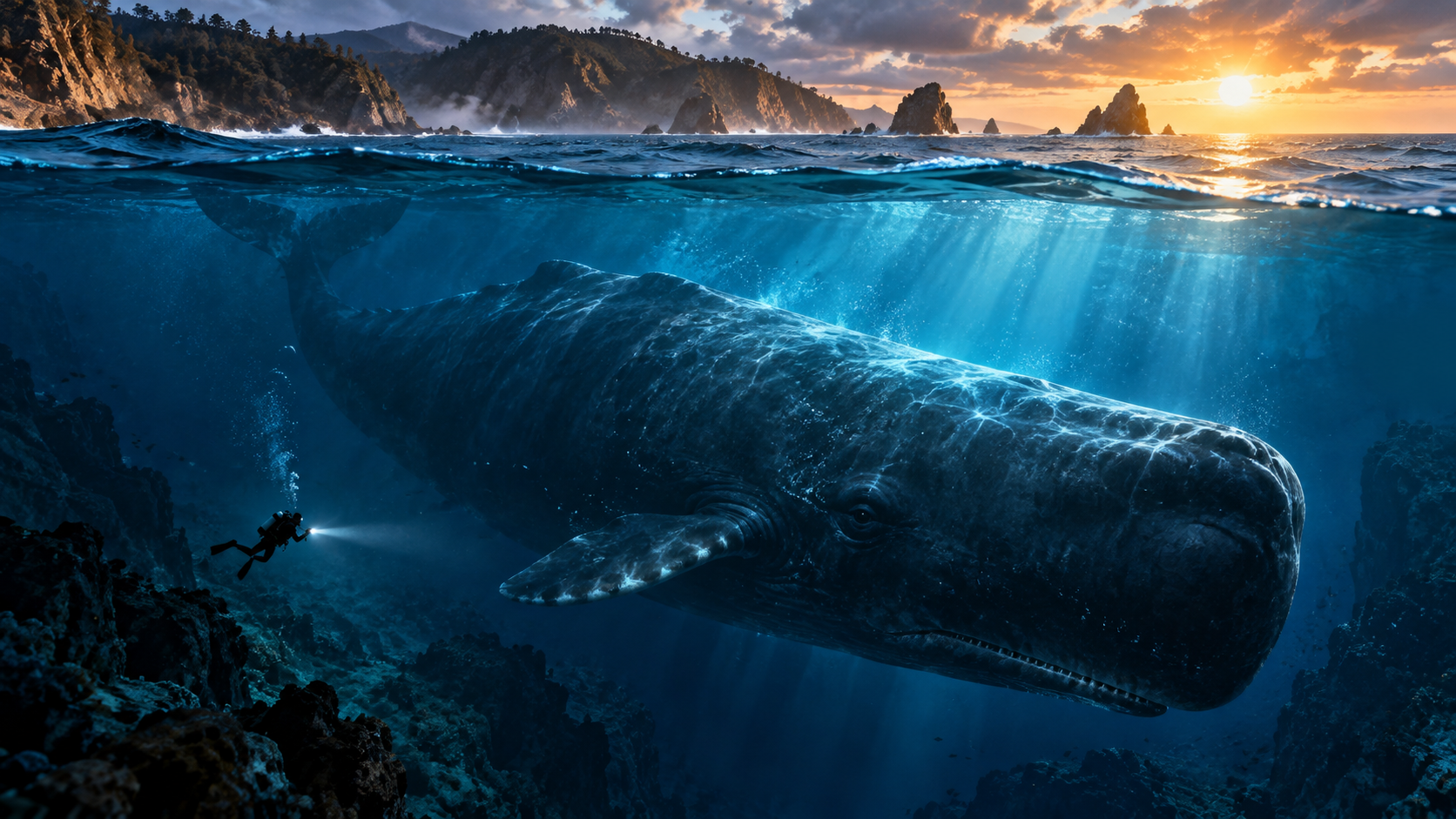
Whalefall (2026) brings a high-concept survival premise to theaters: a young diver searching for his father’s remains is swallowed by a massive sperm whale and has a limited supply of oxygen to find a way out. The film is scheduled to open in the United States on October 16, 2026. Directed by Brian Duffield and based on Daniel Kraus’s novel, it combines an extreme physical predicament with a family story about grief, resentment and the difficulty of understanding a parent after a relationship has been damaged. This spoiler-free preview looks at the official premise, cast, book-to-film challenge and what viewers may want to watch for when the film opens.
Whalefall: at a glance
- US release: October 16, 2026
- Genre: Survival thriller
- Director: Brian Duffield
- Screenplay: Brian Duffield and Daniel Kraus
- Based on: Daniel Kraus’s novel Whalefall
- Cast: Austin Abrams, Josh Brolin, Elisabeth Shue, John Ortiz, Jane Levy and Emily Rudd
- Studio: 20th Century Studios
See the official studio page for the latest synopsis, release information and rating.
A survival thriller built around an unusual space
The official synopsis follows Jay Gardiner, played by Austin Abrams, who dives off California’s central coast while searching for his father’s remains. The expedition becomes a fight to survive when Jay is swallowed by a sperm whale. With a dwindling oxygen supply and little room to manoeuvre, he must draw on what his father taught him while trying to escape. The setup is immediately understandable, making the film’s central problem easy to grasp without revealing the whole story.
Survival films build tension through limited resources, uncertain information and decisions that cannot easily be reversed. Whalefall compresses those ingredients into an extreme environment. It is not a familiar building or a wilderness where the character can simply travel from one landmark to another; it is an enclosed and unfamiliar space he cannot control. The story therefore needs each new development to matter: discoveries should change Jay’s understanding of his situation or the options he believes remain open.
How Daniel Kraus’s novel translates to the screen
Whalefall adapts Daniel Kraus’s novel of the same name. A story focused on a confined environment presents a specific challenge for cinema: a book can spend pages inside a character’s thoughts, but a film has to communicate inner conflict through performance, sound, editing and selective dialogue. Its success will depend on how well those tools convey both the physical danger and the emotional history driving Jay.
An adaptation does not need to reproduce every chapter or thought to respect its source. A screenwriter can compress the timeline, rearrange revelations or use a visual moment to communicate an idea that the novel explains in prose. The key is to preserve the features that make the story distinctive. For Whalefall, that seems to mean keeping the survival problem and family conflict connected: Jay is trying to escape an extraordinary situation while being forced to consider a relationship that shaped him.
Readers may compare the film with the novel, while newcomers will want a story that stands on its own. A strong adaptation should serve both groups without requiring extra knowledge. It needs to establish its stakes clearly, then let the performances and cinematic setting carry the emotional layers in a way that feels natural rather than explanatory.
Grief, resentment and the father-son relationship
The search for his father’s remains gives Jay a reason to be in the water before the survival crisis begins. The official synopsis also suggests that lessons from his father may become essential to his escape. That creates an effective contradiction: the person Jay has lost is connected to the knowledge that might save him. A survival story can use this tension to explore how a relationship stays present after someone is gone.
Parent-child stories are most interesting when affection, anger, memory and regret can exist together. An old lesson may once have seemed unfair and later appear useful. A disagreement can look different when a person has more information. These ideas can make the survival story about something larger than a physical escape, giving Jay an emotional reason to continue beyond the immediate instinct to stay alive.
The family material still has to fit the urgency of the plot. Memories are useful when they change how the audience understands Jay’s choices, rather than stopping the story without adding meaning. If his history with his father affects what he decides to risk or protect, the physical struggle may also become a story about deciding which parts of the past to carry forward.
Building suspense in a confined setting
With an enclosed environment at the heart of the premise, sound and visual design will be especially important. A small detail can become significant when the audience understands that Jay has few options. A sound may suggest movement beyond his view, while a brief glimpse of light can reveal part of a space without explaining everything. A close-up can make a small decision feel consequential when there is no easy alternative.
The challenge is avoiding repetition. If the movie relies only on making the walls feel closer, the setting may become a gimmick instead of a source of evolving suspense. Each sequence needs a distinct problem, a change in what Jay knows or a decision that alters his next move. A contained thriller works when the limited location encourages inventive storytelling instead of restricting the film to the same scare or obstacle again and again.
The protagonist’s emotional state can influence how the environment is presented. A person under pressure notices different details than a relaxed person would. Editing can move between external events and Jay’s attempt to process information, helping viewers feel both the practical danger and the strain of deciding while frightened. Suspense is strongest when the audience understands what the character wants to do and why the next choice matters.
The whale premise and the question of realism
Whalefall starts with an extraordinary event, so viewers may wonder how realistic the story is. The movie is marketed as a survival thriller, not a marine-biology documentary. A sperm whale’s size and the ocean’s scale make a striking premise, but the dramatic rules will matter as much as the scientific details. Even a highly unusual setup needs internal consistency: the audience should understand the limits of the situation and see those limits applied in a stable way.
Realism has more than one layer. An initial event may be rare or heavily fictionalised, while a character’s emotional response can still feel believable. Viewers often accept a high-concept premise when the decisions that follow it make sense. They may lose trust when the movie changes its rules whenever it needs a surprise. Questions about time, space, physical limits and the character’s options will shape the film’s credibility.
Anyone interested in actual whale biology should consult reputable marine-science sources separately. A fictional thriller may simplify details for dramatic purposes, so it should not be treated as a practical guide to animal behaviour or ocean safety. For the movie, the central question is whether its premise develops into coherent suspense.
Cast and character stakes
Austin Abrams plays Jay, with Josh Brolin as his father. The supporting cast includes Elisabeth Shue, John Ortiz, Jane Levy and Emily Rudd. Because the main setup is so focused, performances will have to provide emotional information that the setting cannot. Jay needs to feel like a person with a history, and the father-son relationship needs enough specificity to make the memories matter.
In a confined survival movie, the lead actor may carry long stretches with little dialogue. Small reactions therefore matter: a pause, a look of recognition or a shift in confidence can communicate pressure. If the performance makes Jay’s choices understandable, viewers can stay engaged even when the environment is visually limited.
Supporting characters may appear through memories and relationships rather than continuously. Their importance depends on whether the story gives the audience a clear sense of what they mean to Jay. A parent who exists only as a symbolic lesson can feel thin; a relationship with contradictions and unresolved feelings can make the central struggle personal.
What viewers should expect when Whalefall opens
20th Century Studios lists October 16, 2026 as the US theatrical release date and classifies Whalefall as a PG-13 survival thriller. That makes it one of the coming weekend’s notable releases for viewers who like high-concept stories with a personal theme. Release dates and ratings may differ in other countries, so international readers should check local listings.
Because the wide release is still ahead at the time of writing, a definitive verdict based on public audience reaction would be premature. Marketing and the official synopsis can establish the setup, cast and creative team, but they cannot guarantee the finished execution. After release, useful questions will include whether the confined setting produces enough variety, whether the father-son material develops naturally and whether the survival mechanics support rather than interrupt the tension.
Viewers who enjoy contained thrillers and family stories may find the premise appealing. Those who prioritise strict realism may want to read more reviews after release. In either case, checking the official rating and local cinema information is better than relying on old release calendars.
Preview verdict: a strong hook with emotional potential
Whalefall has an immediately understandable survival hook, an unusual setting and a family conflict that can give the physical danger extra meaning. The oxygen limit creates urgency, while Jay’s search for his father’s remains connects the story to grief, memory and the difficulty of accepting a complicated relationship.
The main tests will be execution: whether the limited space continues to create new problems, whether the film follows consistent rules and whether the emotional material strengthens the suspense. This is a preview, not a personal review of the finished movie. Once audiences can see the film, the final verdict should be updated with direct viewing and a closer assessment of performances, pacing and payoff.
Whalefall (2026): common questions
When does Whalefall release?
The US theatrical release date is October 16, 2026. Dates in other countries may differ.
What is Whalefall about?
Jay Gardiner dives off California’s central coast while searching for his father’s remains and is swallowed by a sperm whale, leaving him with a limited oxygen supply to find a way out.
Who directed Whalefall?
Brian Duffield directed the film and co-wrote the screenplay with Daniel Kraus, author of the source novel.
Who stars in Whalefall?
The cast includes Austin Abrams, Josh Brolin, Elisabeth Shue, John Ortiz, Jane Levy and Emily Rudd.
Is Whalefall based on a book?
Yes. It is adapted from Daniel Kraus’s novel of the same name.
Is Whalefall a true story?
No; it is a scripted adaptation of a novel, not a documentary account of a real incident.
What genre is Whalefall?
The studio categorises it as a survival thriller.
What is the film’s age rating?
The official US listing says PG-13. Check your local rating board for your country’s classification.
Where can I watch the official trailer?
Visit the official 20th Century Studios page, which includes the trailer and release information.
Is this a full review of the finished film?
No. This is a pre-release preview based on official information. A final verdict should follow direct viewing after release.
Official information and further reading
- 20th Century Studios — official synopsis, cast and release date
- Box Office Mojo — October 16, 2026 release schedule